Reiki (pronounced Ray-Key) translates loosely as “Universal Life Force Energy.”
It is a gentle, hands-on healing practice that supports relaxation, balance, and the body’s natural capacity for healing. While some experience Reiki as a spiritual practice, it is not affiliated with any particular religion, creed, or doctrine.
Many people seek Reiki during periods of stress, illness, recovery, grief, transition, or when they simply feel out of balance. Others are drawn to Reiki as a way to deepen their connection with themselves and cultivate greater clarity, presence, and well-being.
Reiki is intended to complement, not replace, appropriate medical or mental health care.
Every Reiki session begins with a brief conversation about your goals and intentions for the session and concludes with time to discuss your experience, observations, and any insights that arise.
Clients remain fully clothed throughout the session.
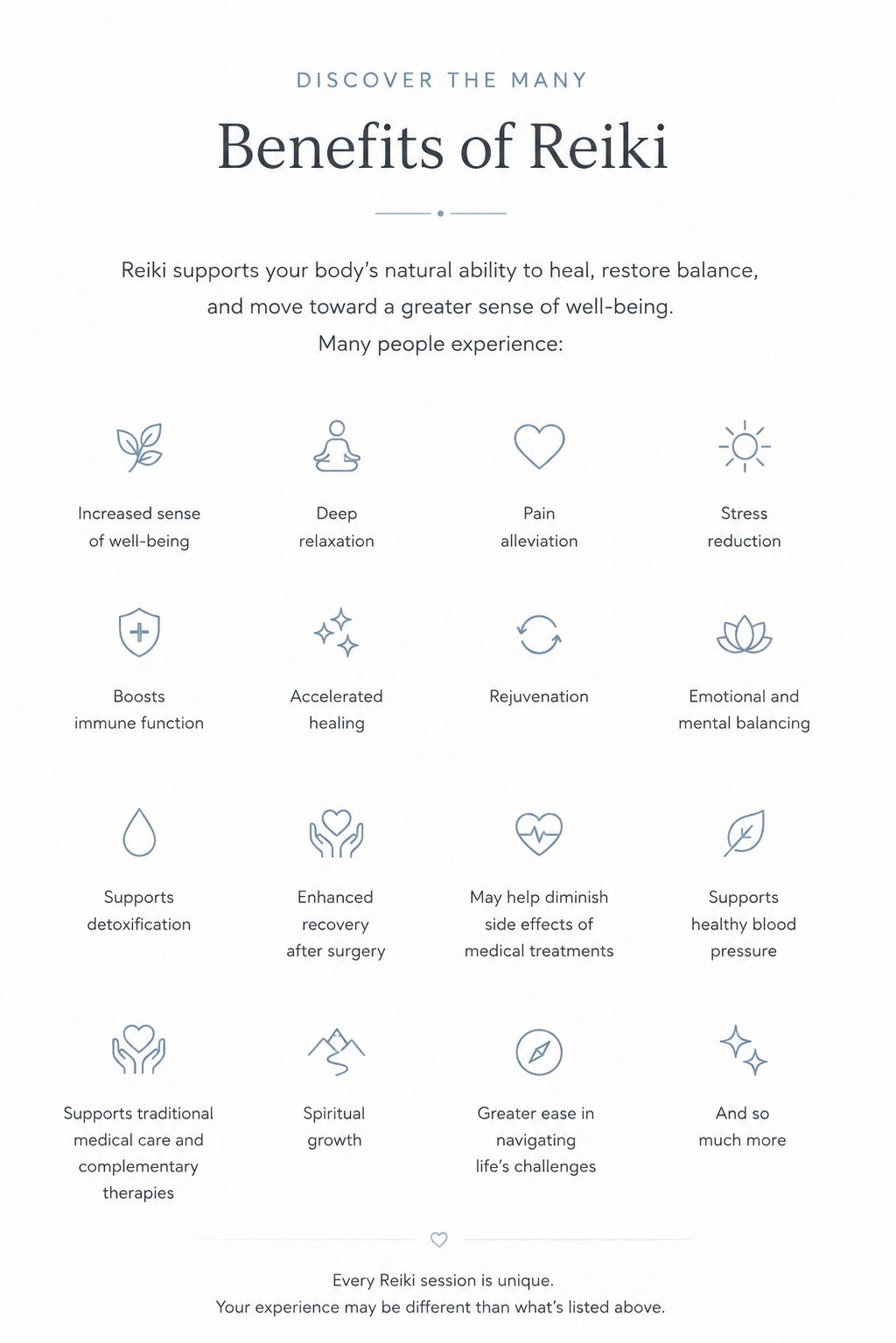
Many people experience deep relaxation, warmth, tingling sensations, emotional release, or a greater sense of calm and clarity. Others simply experience a quiet sense of rest. There is no “right” way to experience Reiki, and each session can feel different.
The effects of a session often continue to unfold quietly over the hours and days that follow.
In-person Reiki sessions take place with the client comfortably resting on a massage table.
A series of light-touch hand positions are used throughout the session. Approximately halfway through, clients are asked to turn over so the session can continue from both the front and back of the body.
Distance Reiki sessions are offered via Zoom and can be experienced in one of two ways, depending on your preference.
Some clients prefer to receive Reiki quietly while Amy sends Reiki in real time during a Zoom session. Following the session, there is an opportunity to discuss observations, feedback, and insights.
Other clients prefer a more conversational experience. During these sessions, Amy shares observations as they arise while actively sending Reiki. Breathwork, visualization, and discussion may be incorporated when appropriate.
Both approaches are equally effective. The choice is simply a matter of personal preference.
The benefits of a Reiki session often continue beyond the time spent together and may unfold gradually over the following days.
After a session, it can be helpful to:
• Drink plenty of water
• Allow time for rest if needed
• Spend time outdoors
• Pay attention to physical, emotional, and energetic shifts
There’s no single schedule that works for everyone.
Some clients benefit from a series of sessions scheduled closer together, particularly during periods of heightened stress, recovery, or major life transition. Others find that occasional sessions provide the support they need.
Together, we can discuss what feels most appropriate based on your goals and circumstances.
Enhance your session with the support of crystals through a Crystology session.

I was first introduced to Reiki during my senior year of college. Even before experiencing it for myself, I knew I wanted to learn more.
I began my Reiki training in 2001 and completed Reiki Master Teacher certification in 2002. Since then, Reiki has remained a steady part of my life and practice.
Over the years, I’ve offered Reiki sessions and certification training throughout Boulder County, supporting clients through periods of stress, healing, transition, and personal growth.
What continues to draw me to Reiki is its simplicity. Again and again, I’ve witnessed the profound impact that rest, presence, and compassionate attention can have on the healing process.
More than two decades later, it remains one of my greatest privileges to share this work with others.